Thursday, January 28, 2010

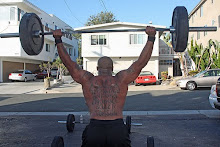
Part One: A Basis for Using the “Full Olympic Lifts” in Training


Lately, I’ve been reading many articles and different points of views pertaining to the Olympic lifts and their use in training athletes. Many people say that the lifts are nothing more than a means to reach triple extension and that there are other ways to achieve this such as by jumping, bounding, or performing squat jumps, box squats, kettlebell swings, and tire flips.
People have various opinions and stances on training, but I think the biggest factor is to find what works best for you in your given event and in your personal goals. There are so many different ideas and principles out there for training athletes in power sports from the conjugate method to the whole stability ball, “functional strength,” and sport-specific movement.

I’m a huge advocate of the Olympic lifts. They’re athletic, powerful, and precise. Yet each lift is really one simple movement that activates everything between your fingernails and your toenails. They can be very addicting, too. It just feels good to hit rock bottom and catch a snatch over head or stand up with a heavy clean and stick the jerk. And they’re just plain ole’ work! I’m not talking about power cleans or power snatches but the lifts in their full form. I think they’re an excellent exercise not just for athletes but for anyone including your grandma.
I remember watching 85-year-old Mel Katz compete while a member of Peaks Weightlifting Club in Flagstaff, Arizona. Most 85 year olds are just trying to get out of bed. By the time you hit 25 years old, if you haven’t regularly used or overloaded your fast twitch muscle fibers, they begin to atrophy. They continue to atrophy if not overloaded, more and more each year until finally you can’t even get yourself up out of your favorite TV chair. Then before you know it, you’re 85 years old stuck in a nursing home bed being spoon fed Jello.

The physiological workings of the human body are truly quite amazing. We know that strength is the ability to exert a force. Force is equal to mass times acceleration. The basis of all motion is force. All activities in life require the movement of an individual or the ability of an individual to set a given piece of equipment in motion, like getting up out of our favorite TV chair or the ability to pick up a hammer and drive a nail into the wall. And then you have power, which is equal to force times velocity. Power is the rate of work we are able to accomplish in a given unit of time. By increasing a person’s power output, you can increase the probability of athletic success in any given event. A 60-foot shot putter is now able to throw 65 feet. An 11-second hundred meter sprinter is now able to run 10.5 seconds. The greater we can manipulate power output, the bigger the results in improvement will be (but it’s important to remember that efficient transfer of the power into a given event can only happen through precision technique, which comes by actual practice of the event itself).

It would be nice if increasing power was as easy as it looks on paper. We would all be Christian Cantwells or Usain Bolts, winning medals and breaking records. But every athlete has his or her own genetic capabilities and limits. What makes a training program successful is being able to help each athlete reach his or her maximal potential, even go beyond it, while avoiding injury and enjoying the journey. So what we choose to do in any allotted training time (i.e. types of lifts, volume, intensity) is of optimal concern. We want to choose the things that will help us to safely achieve the best results with the least amount of effort and/or time.

There are only two ways to increase an athlete’s ability to generate power—increase the strength of the muscles that exert the force or increase the velocity of the movement being made. While the exact physiological cause of increased strength isn’t known, we do know where the possible sites of adaptation can take place. In the nervous tissue, changes in the nervous system can result from the effects of a proper stimulus. As a result of neural adaptation—an increased neural drive to the muscles—an increase in the synchronization of motor units or an inhibition of the protective mechanism of the golgi tendon organs can occur. All of which allows your body to react faster and produce more power over time.

In the muscle tissue, hypertrophy (the increase in cell size) or hyperplasia (the splitting of the cell) can occur. When we strength train, we stretch the muscle, which then signals the body to release the hormones that lead to hypertrophy (muscle growth). In the connective tissue (the transmitter of force), as a result of a heavy stimulus overload, adaptations can lead to an increase in collagenous fibrils, making your connective tissue stronger.
In the skeletal tissue, an increase in the density of the bone can result from strength training due to an increased deposition of mineral salts in the skeletal tissue. Bone modeling is a response to mechanical loading by application of a weight bearing force, which causes the bone to bend, thus creating a stimulus for new bone formation at the regions experiencing the greatest deformation.
The Sports Science Exchange gives these qualifying characteristics of a bone-building exercise:
· It should involve faster rather than slower movements.
· It should exceed 70 percent of maximal capacity.
· It should involve some type of impact.
· It should involve a variety of muscle groups and movement direction.
· It should be a closed kinetic chain activity (standing on your feet).
And then there are the factors that can affect speed. You can improve the power to weight ratio. You can develop better mechanically advantageous techniques in your given event (good technique is important in anything we do). You can decrease resistances to movement by losing fat, improving joint mobility, or increasing flexibility. You can train the central processing mechanisms of the stimulus-response component (fast twitch muscle fibers) to react faster. Or you can maximize the awareness of signals (cues to attend to).

Now, after examining the physiological properties of the body and how adaptations take place, we can ask ourselves, what movement in sport best facilitates these factors in promoting the generation and production of power as well as the positive adaptations we seek in performance and body composition? Yes, I would say the Olympic lifts are an amazing fit. There is a reason why Olympic weightlifters are some of the most powerful and amazing athletes on the planet.

What other lift or movement in sport overloads and stretches the whole body’s muscular system (not only forcing the large muscle groups to fire but sending a chain reaction throughout the body to every muscle) to the point of hypertrophy while also promoting an increase in the collagenous fibrils of the connective tissue, meeting the criteria for a bone-building exercise, training the nervous system for optimal responses, training the body to move in precision at maximum speed (mechanically advantageous techniques) and at the same time requiring enormous flexibility and joint mobility while being safe (if done correctly with good technique) and able to produce results in the least amount of time and with less effort than combining a bunch of exercises in hopes of manipulating the same results? And in what sport do athletes have a greater power to weight ratio than Olympic lifters? So why would we not incorporate these lifts into our training programs?

In my next article, I’ll play the role of antagonist to many of these common arguments against the use of the “full Olympic lifts” for training athletes of all levels of performance.

Wednesday, January 27, 2010

Mental Toughness


Mental toughness is a personal, persevering decision. You can view this as an athlete's desire to continue exercise, even when passing through higher and higher levels of fatigue. I began experimenting with myself and fatigue this year after the Games and came to see some interesting results. I used to believe that everything about fatigue could be defined physiologically. I would see myself working out and envision the physiological mechanisms that were running out to and stopping my performance.

There are 5 physiological mechanisms of fatigue that I am concerned with. Depletion of energy systems, inadequacy of the circulatory and respiratory systems, body temperature elevation, neurological insufficiency and dehydration can all lead to fatigue. As I read more about these mechanisms I saw that all of them had their short comings. How do you explain the marathon runner that can run a 4 minute mile pace with a heart rate of 200? How do you explain the man who, at risk of death, was able to tread water for 40 hours until he was rescued? Surly their systems had run out. Further still, how do I explain the fact that the other racers in that marathon had the same potential physiologically, but couldn't keep up? Or what about the other two treaders that could not stay above water and were lost at sea? There is one explanation: mental toughness stems from the interaction of the mind and the body.

Mental toughness can be seen as desire or will power. Interesting studies have been performed on sedentary and professional athletes and their ability to withstand exertion. Sedentary people always gave up early, with no real signs of approaching any true fatigue. The professional athletes, on the other hand, were able to withstand huge amounts of work and go on.. So what's all this mean? that mental toughness can be trained just like any other skill. to get to a higher level you must continually push the envelope of your own limits... So what's it going to be???? You wanna be tough as nails mentally, then train for it or continue to be a mental midget.... The choice is yours......

Tuesday, January 26, 2010

Basketball Agility and Foot Speed Drills

One of the guys at CF 949 has asked me about posting basketball conditioning workouts.... Well I played basketball in high school but really used it to keep in shape after Football season and before baseball season. So here is my attempt to put together some agility and foot work drills for basketball players...


Agility ladder drills
These are often associated with other sports (such as soccer or football), but every basketball player should use an agility ladder to work on their foot speed and agility.
There are various drills you can do with an agility ladder, but here are a few basics to get started:- One foot hop (go through each box hopping on one foot, then do again with the other)- Two foot hop (go through each box using both feet)- High knees (go through the boxes bringing your knees up high)- Two feet in each box (using a running motion, step into a box with your right foot, then your left, then into the next box with your right, then your left and continue this pattern)- One foot in each box (same as above, but this time, only one foot will land in each box)- Sideways one foot in each box (sliding to your side, you'll put one foot in each box)- Sideways two feet in each box (same as above, but both feet will hit the ground in each box)

Jump rope drills
Old school? No doubt about it. But also very effective. Jumping rope is a great way to get warmed up for a workout, but it's also a great way to work on your foot speed. Here are a few drills:- Speed jumps (jump fast, and we mean as fast as you can)- One leg (alternating between your right and left foot...for example, jump 4 or 5 times on your left foot, then move to 4 or 5 jumps on your right)- Running jumps (jump rope while moving from one end of the floor to the other...it's more a fast walk than a run, but you get the idea)


Cone drills
Cone drills are great at making you faster. Here are a few good drills I use with my clients:- Sliding drills (place 2 cones 6-8 feet apart and defensive slide from one to the other...then move them 10-12 feet apart and do the same. They key is to slide fast...very fast.)- The T-Cone drill (place 3 cones in a straight line about 3 or 4 feet apart, then place 2 other cones about 10 feet apart at the top of the "T". Now, start off running back and forth between the 3 cones and out to one of the cones at the top, then back-pedal to the starting spot. Do the same thing again, this time out to the other cone at the top, and back-pedaling to the start). Go FAST.

These are just some of the drills you can do as part of your foot speed and agility training. Check back soon...I'll be adding more details in the weeks to come.

Monday, January 25, 2010

Conditioning—When and How?


Now that football season is coming to an end, many kids are looking to get stronger and faster for next season. There are many things that go into preparing kids for the next season, and conditioning is one of those things that usually isn’t done correctly. I’m sure many of you have seen people pushing the Prowler on YouTube until they puke or you’ve heard some of the ridiculous conditioning tests that some athletes have to perform. Every team has its own way of doing things. I just don’t agree with most of them.


There are many aspects to programming the conditioning of athletes. You have to know when the season starts, what type of energy system the sport requires, if the athletes have any conditioning test they have to perform, and how good or bad of shape they’re already in. These are crucial in developing a successful program.Ideally, you want to do conditioning separate from the actual workout so that the athletes can maximize growth from their workout with proper recovery and nutrition. After a workout, glycogen stores are depleted. Athletes need to generate the anabolic process by getting in the proper nutrition to start protein synthesis so their bodies can repair and regenerate. That’s the purpose of training to get bigger, stronger, and faster. So why waste a second with conditioning when they should be focused on recovering?That’s the ideal situation, but if you’re training athletes in your gym, that will most likely never be the case. They want to get in and get out without having to come another day or session to get conditioning in. If that is the case, you have to maximize their time with weight lifting followed up with conditioning.


We have our guys do conditioning that complements their training. So if it’s leg day, we will have them either push the Prowler or pull the sled. This will allow them to continue to train their legs and get some conditioning in. If their season is four months away, don’t even worry about conditioning. Just focus on getting them stronger and bigger. Once they’re two months away from the start of the season, we start to incorporate conditioning unless they’re extremely out of shape. Then we start three or maybe even four months out. This just depends on the person and the situation.Every sport requires certain energy systems. You have slow oxidative, fast glycolytic, and ATP-PC. Most of your athletes play in an ATP-PC and fast glycolytic sport, so you have to prepare them for that. The keys to achieving this are to have as much capacity in both systems as you can and to reduce the factors causing fatigue.If the sport requires these two systems to be used during the game, you must train your athletes to reach the highest levels possible in order to master their sport. You have to have the exercise mimic the actual sport in duration and intensity. The high intensity conditioning will increase the glycolytic enzymes in all fiber types, which will increase the amount of ATP that can be generated. It will also increase the speed at which PC can be degraded so that faster ATP turnover is possible.


If they play football, have them do a conditioning exercise for 5–7 seconds and then rest. At the beginning of the conditioning program, make sure you give them a good amount of rest, and then in the preceding weeks, lower the rest, increase the reps, or increase the weight. This will allow them to strive for something new every week when it comes to conditioning. Conditioning should be like max effort days. Your athletes should have a goal to beat. You want them setting PRs in the weight room and when they condition.Every school will have a conditioning test that the athlete must perform. Much of the time, they don’t make any sense, but none the less, the athletes are judged by how well they perform. You must train your athletes to be proficient at their tests, but it shouldn’t be a basis of their conditioning program. As long as you can increase their aerobic capacity and lactic threshold, just running the test once a week will be sufficient enough training.


Here are a few key points that you must know in order to maximize your athletes’ training.
· Don’t start conditioning too early in the off-season. This is a crucial mistake that I see many coaches make. Give the kids time to heal up after season and give them time to get strong and fast. I wait until six weeks out from their season. This is all you need to get into shape. If you start any earlier than that, you’re overdoing it.


· Don’t make their speed work turn into conditioning. Many coaches fall for this one. They think running the athletes into the ground until they can’t move anymore will make them faster. You have to treat speed drills like max effort work in the gym. You need to make sure they get full recovery before starting the next rep. Speed is speed, and conditioning is a whole other beast. Treat it that way and you will see incredible gains.


· You have to program their conditioning like you do their weight lifting. There has to be a rhyme and reason to what you’re doing. Start off light and with long rest periods and then gradually increase the weight or reps and decrease the rest as their conditioning progresses. Have a goal that you want them to make. That goal should be accomplished at the end of their conditioning cycle.


· Build their conditioning from the end to the beginning. This kind of goes with the point above, but when designing their programs, start with the last day and have that be their test day. Build the program all the way back to the first day.


· Make the conditioning specific to their sport. This means that football players shouldn’t be running miles for conditioning. The longest a football play lasts is around six seconds with a rest in between plays of 25–30 seconds. This should be the basis of their conditioning.


There is much more that goes into conditioning, but if you follow these five steps in programming off-season conditioning, your athletes will excel at their sports because they will be able to outlast the opponent. That is where the game is won—in the fourth quarter, the last inning, or the last mile.

Sunday, January 24, 2010

Leg Training for Linemen: The Top Eight Lower Body Movements for the Big Men

One thing that absolutely baffles me about most football strength training programs is that everyone does the same thing. The linebackers go through the same training as the quarterbacks. The wide receivers do the same exercises, sets, and reps as the linemen. As if we weren’t different enough as individuals, now we’re going to take guys who perform extremely different functions on the field and have them all train the same way? Sure, there are many similarities. There’s a base of movements and exercises that everyone should do. However, how, when, and how much of them is quite different, especially when it comes to the big guys up front!
Some key points to remember about linemen are:
· They are much bigger than the rest of the team.
· Their recovery ability will either be much less or much more than the other guys (more on this later).
· Their job is to move another huge, strong, and explosive guy using strength from their hips, legs, arms, back, and just about everything else.
· Their secondary job is to be able to move quickly through space and keep guys off of their quarterbacks. This often involves moving laterally and blocking players who are much faster (corners, safeties, linebackers).

Linemen are workhorses, right?
Most linemen need tremendous amounts of work. They’re built big and can handle a ton of work. In fact, some need this high workload to thrive. However, there are some big guys who, by virtue of being so large, have lessened recovery ability. This is usually tied to poor eating (we’re talking about high school and college players who are quite large with high levels of body fat).
This will sound odd, but if you’re this guy or you coach these guys, the first thing you should do is have them lose some fat. Yes, I know. It’s all about having the biggest linemen on the field. And most guys will point to the NFL, specifically the Dallas Cowboys from the 90s who had enormous linemen. Sure, we all watched Madden circle ole’ Nate Newton’s belly, but the reality is that those guys had tons of muscle and were bull strong. (There’s a video of Newton benching 700 lbs). If a linemen is too fat, he will need to be twice as strong just to move out of his own way. Because this is difficult to do, it’s best to just drop the excess weight. I’ll have a fat loss article specifically for linemen coming soon. Until then, stop shoveling in the junk food!
Now, for those who do have a high work capacity, let’s get to work. We’ll look at the top eight exercises for linemen (both offensive and defensive) and how and when to do them. The subtle changes make all the difference in the world.

1. Box front squats
Want explosive linemen? Want linemen who can physically dominate their opponents and bulldoze their way down the field? Then adding box front squats to your football training program is the first thing you should do.
While lesser known than its cousin the box squat, the box front squat is actually more effective for linemen. If you’ve ever seen one done, you’ll notice that the position is almost identical to the blocking/driving position—chest up, arms out, and hips and legs working to go from a static position (your stance) to a dynamic position (driving through the other guy). This is about as close to sport-specific as one can get.
Many put the front squat down because it has less of an impact on the posterior chain, but this is nonsense. The quads can’t be ignored! Plus, when doing front squats on a box, you involve the glutes and hams to a much greater degree. These are quite easy to teach. You need a box that is at least parallel. Ideally, an adjustable box should be used so that you can vary the depth. Unrack the weight with the bar resting high on the chest near the clavicles. Keep the bar high so that the stress on the wrists is greatly reduced and the bar is in a more secure position.
Now sit way back and lower yourself under control on to the box. Relax the hip flexors, pause for a beat, and then explode up. Don’t rock while on the box! Performing box front squats will push your hip, glute, ham, abdominal, and quad power to the absolute maximum and will improve any linemen’s ability to drive, block, and bulldoze opponents. Keep the reps under five and the sets medium to high. These are a perfect max effort movement. They can also be used with chains or bands for an excellent speed movement as well.

2. Deadlifts
Deadlifts are the king maker. Before I go on, let me say that some of you may have heard that dead lifting is bad for the back or some other such douchebagery. This is plain ole’ crap. When done properly, the deadlift and its variations may be the single best builder of strength and speed known to man. If all you could do was deadlift, you’d be head and shoulders above the guys who bench and curl ad nauseum. It still sickens me when I hear from athletes who tell me their coaches tell them not to deadlift.
Deadlifts are ultra important for several reasons:
· They build tremendous starting strength. Many linemen are woefully lacking in the ability to get explosive and apply strength quickly. Failure to do this will result in poor performance on the field.
· Deadlifts strengthen the posterior chain, building power and strength in the hamstrings, glutes, calves, and the entire back
· Deadlifts, like squats, build insane strength in the hips—the seat of power for all sports.
· They build slabs of muscle. Nothing will make you grow from your calves to your traps like heavy deadlifts. For young linemen who need to get bigger, deadlifts are the way to go!
· The deadlift can be extremely useful for injury prevention. Some believe that the moderate to high hamstring activity elicited during the deadlift may help to protect the anterior cruciate ligament during rehabilitation. You can and should use many variations of the deadlift to round out your training and keep yourself working as hard as possible.
The deadlift has many forms including:
· Snatch grip
· Sumo
· Rack pulls
· Hack deadlifts
· Trap bar deadlifts
This is only a short list of some of the many variations of the deadlift that should be used.
Deadlifts can be used as max effort, dynamic effort, or moderate rep exercise. The classic 5 X 5 protocol applied to the deadlift can put more muscle on your frame than most other exercises combined.

3. Sandbag clean and push
Sandbags are alive. They move, change positions, and fight you every step of the way. Sounds a lot like a live opponent to me. Live opponent work ties in closely with the concept of strength leakage. Weights are fixed. They stay balanced, evenly distributed, and constant. This is good when it comes to building maximum strength, but it can hinder the transfer of power to taking on a live opponent. Wrestlers, fighters, and martial artists have used sandbags for centuries because of their effect on strength when fighting someone. For the most part, football is a three-hour fight. In every play, you line up and fight your opponent. He won’t stay in positions that allow you to block or tackle him. No, he wants to make your job as hard as possible.
Power cleans have come under fire in the last few years because many coaches believe they are difficult to teach and aren’t as effective at building speed as dynamic effort movements. Both of these points are valid. But by using a sandbag in place of a barbell, we get around both problems.
Sandbag cleans are the perfect movement to build the entire upper body, specifically the upper body muscles responsible for controlling your opponent at the point of attack. Adding an explosive push on the last clean is a great way to learn to transfer power from the legs through the upper body. Load a bag and clean it in any way you see fit. Use the various handles or mixed grips or just grab the bag itself. Now clean it to chest height. When I say clean it, I don’t mean end up in one of those “split the legs eight feet apart” kind of clean position. No, I mean finish the clean in the good football position just as you would pre-block, tackle, jump, and sprint.
If you’re new to using sandbags, check out Josh Henkin’s stuff at Sandbag Training Systems. His sandbags are the highest quality I’ve ever seen!

4. Romanian Deadlifts
Romanian deadlifts are an excellent assistance exercise for linemen. All linemen need big, strong, explosive hamstrings. Romanian deadlifts build muscle and power in the hamstrings and glutes and also hit the lower back quite well.
The Romanian deadlift is great for any football player because it’s performed in a stance very similar to the “ready position” (hips down, knees bent, flat back…think a linebacker or the position of the body pre-jump).
Romanian deadlift at mid-point.
For many athletes, the Romanian deadlift is a far superior exercise to the straight leg deadlift. This is especially true for some of the taller linemen. For anyone with a long torso, the single leg deadlift can become a lower back exercise and damn near neglect the hamstrings. But because of the hip position (traveling backward) and the intense pre-stretch of the hamstrings, the Romanian deadlift is much better at working the posterior chain. Romanian deadlifts can be done as your max effort movement, especially if you do them in the rack.

5. Snatch grip deadlifts
We already talked about the importance of doing deadlifts, and as far as the deadlift variations go, none are more perfect for football training than the snatch grip deadlift. Because of the wide grip, your body is forced into a much lower position than with a normal deadlift. This hits the hamstring and glutes extremely hard, which is always a good thing for any linemen.
Begin just as you would in a regular deadlift, but your hands will be much further apart. Don’t go collar to collar unless you’re extremely tall. Your index fingers should be on or an inch outside of the outer rings. Be sure to sit back and pull hard. A nice side benefit is all the extra work your back and traps will get.

6. Dumbbell incline
I’m often hated for saying this, but I believe the dumbbell incline is a much better movement for linemen than the bench. Obviously, the bench press is a great exercise, but when it comes to athletes—not powerlifters—the incline rules. The dumbbell incline much more closely mimics the path taken by the arms in many athletic movements such as blocking and punching and in many wrestling moves. For linemen, this is crucial. Keeping the elbows in and pressing out and up is exactly what we do on the field. The incline is also much better at developing the all important shoulder girdle. It’s a nice compromise between the overhead press and the bench, allowing an athlete to hammer the shoulders, pecs, and triceps. For those with shoulder problems, the incline can be a life saver. When I had rotator cuff problems, benching even super light weights felt like I was being stabbed in the front delts! But I was able to continue doing inclines as heavy as I could handle. When I fixed my shoulder problems, I returned to the bench and lost very little progress. The dumbbell incline is also incredibly versatile. You can use it for timed sets, high reps, or moderate reps, or you can go super heavy and treat it as a sub max movement. If you’d really like a challenge, try doing a one arm dumbbell incline. Now that’s real “core” training! Again, for those young, small linemen, these can be a great way to add quality muscle and weight to your frame.

7. Lateral lunges
Somehow we all forgot about moving sideways. Offensive linemen often have to slide block, drop step, or post and gather. Yet 99.9 percent of most football training programs only focus on straight ahead speed and strength. I realize that most hate lateral movements because of the ego hit you take when doing them. A simple 135 lbs has left many strong squatters sore beyond belief. This should tell you that there’s an awful lot of muscle not being worked with squats and deadlifts alone. Adding lateral lunges is easy. Plug them in after your max or dynamic effort movement for 3–4 sets of 8–10, and you’ll notice a huge difference in your lateral speed.

8. The Prowler
The Prowler, which is a crazy looking sled that because of a set of handles and a set of uprights can be either pushed or pulled, absolutely owns all other forms of conditioning for linemen. The Prowler should be part of any football training program. No question. Sleds are good, but the ability to get into a blocking position and drive a weighted sled is invaluable. Both offensive and defensive linemen will see their conditioning levels go through the roof after only a few sessions on the Prowler. Plus, you can easily pull or push it laterally, which as we already discussed, is very important. Use the Prowler as a finisher or on a non-lifting day as a way to condition. Because of the lack of eccentric movement, the Prowler won’t cause much soreness, which is a huge advantage for athletes. One of the biggest issues when designing a training program for an athlete is how to give strength, speed, and conditioning their proper due without compromising any of the elements. Use the Prowler for sprints, walking conditioning, or relays, or load it up for strength work.

Wrap up
Start adding these movements to your training, and you’ll become a better lineman. It’s that simple. For coaches who need to get a crew of out of shape or skinny guys and turn them into a cohesive unit of bulldozers, these movements are a must do!

Friday, January 22, 2010

I don’t claim to know it all in regards to warming up or even pretend to know what warm-up method is best for each individual lifter, athlete, or average Joe. In fact, the more I read and learn, the more I realize what I don’t know. What I would like to offer in this brief article are ways to maximize the effectiveness of the warm up while minimizing the possibility of any detrimental effects. And, yes, the warm up can be detrimental. We will get to that.


First, let us get back to the basics. What are the benefits of a warm up? Increased blood flow to muscle tissue and joints and raised core body temperature You’re probably thinking, “Yea, yea, yea. I’ve heard this one a thousand times before.” I encourage you to review your warm up if none of the following are included: jogging, jumping rope, lateral shuffles, jumping jacks, seal jacks, X jacks, gate swings, body weight squats, marching, skipping, pogo hops, bear crawls, lizard crawls, mountain climbers, and inch worms. Blood flow to the tissues we’re about to work is crucial to injury prevention, and pliability of these tissues can’t occur unless we’re moving, not farting around.


Don’t forget that certain joints have a synovial membrane, which provides fluid and lubrication to protect the joint and allow it to glide freely. Imagine driving a car without brake fluid or oil for the engine. It wouldn’t last very long, and it wouldn’t perform effectively and safely. Remember the kinetic chain. Once one link is broken, the rest will fall as well.


Increased joint mobility
This one is a biggie. A mobile joint is a happy joint. The weight we have on our backs or in our hands is multiplied by gravity. The weight wants to fall to the ground. Our bodies must overcome that weight through joints that have optimal range of motion. If a joint has an impingement, tracking issue, or inflammation/pain, you can rest assured that your body will find a way to get that weight up using any means possible. That includes using crap form and other weaker joints that aren’t meant to take the load. For example, while squatting, wouldn’t you prefer to have the weight distributed as it should be throughout your hips, knees, ankles, and lumbar spine? I can’t tell you how many times I’ve seen someone at my university gym ride a stationary bike for one minute and thirty seconds, load up the bar with 185 lbs, and try to squat with good form. Are you kidding? His knees shoot forward, his heels come off the ground, and he doesn’t have any lumbar curvature. This is a recipe for disaster. But we are smarter than that.
An immobile joint can also reek major structural stress on the joint capsule itself (ligaments, cartilage) as well as to the surrounding assistive and stabilizing tissue supporting that movement. We have prime movers for a reason. Don’t let the smaller guys do the work. If we aren’t mobile and able to use a full range of motion on a particular exercise, what is the point of doing the exercise?


One of my fellow trainers once said, “There is only one way to squat, Terrance, and that is the right way.” I love how Wendler says, “Don’t be a half rep Magee.” What happens if we push or pull a load past the range we have been training at? I don’t think our joints and tendons would like it very much, especially if it’s a heavy load.


The following are some mobility exercises that need to be included in your warm-up repertoire:
Standing
· Knee hugs
· Frankenstein walks
· Walking quad stretches
· Lunges with reach
· Reverse lunges with reach
· Lateral lunges
· Serpentine lunges
Supine lying
· Single leg hip extensions
· Iron crosses
· Leg kicks
· Clams
Prone
· Knee to elbows,
· Swimmers
· YTW series
· Scorpions (if you like them)
All fours
· Bird dogs
· Fire hydrants
· Cats and dogs
· Hip circles
Dynamic/movement preparation
· Mountain climbers
· Groiners
· Pogos


Central nervous system activation
“Prime the pump,” central nervous system activation can be a great jump start to your workout. The biggest benefit of this is the increase of motor unit recruitment and preparation for the application of force that we must put into the bar. The more motor units we can “wake up,” the better prepared our bodies will be to stabilize and mobilize an external resistance.
Here are some great exercises to use prior to your lifts:
Lower body days
· Box jumps
· Broad jumps
· Pogo hops
· Cro hops
· Vertical medicine ball throws
Upper body days
· Clap push-ups
· Push-ups onto box
· Horizontal medicine ball throws
· Standing partner tire presses
· Clap pull-ups


Muscle activation
This is an often overlooked aspect of training. Over time, we can develop particular movement patterns that can virtually “shut off” a muscle group. The glutes are a great example of this. If we commute, sit down for long hours, and watch football too long on Saturday and Sunday, we can inhibit our muscle tissues’ effectiveness of firing properly and efficiently. In essence, our glutes can fall asleep and not be as effective as they should be when it comes time to lift or do on the field work. The response of the body to this is that it will go into survival mode and use whatever means possible to accomplish the work asked of it. If you decide to do tire flips after a long sit down and without proper activation movements, you can rest assured your low back and hamstrings will do most of the work. This isn’t efficient or smart. The benefits of getting our muscle tissue “activated” is important because we want to make sure that our motor firing patterns aren’t out of whack and that one muscle group isn’t dominating the other (i.e. hamstrings overpowering our glutes during sprinting, deadlifting, etc.). We want sequential firing, and we want to have our muscle tissues working in unison.


Resistance mini-bands are an excellent tool for glute activation. Here are some exercises that should be used in a warm up. Remember, these are just the glutes we’re discussing. I’ll let you use your creativity for other trouble areas.
· Lateral band walks with band above knees or ankles
· Diagonal band walks
· Linear/reverse linear band walks
· Clam openers (lying on side)


Pre-habilitation
In the words of Amy Winehouse, “They try to make me go to rehab. I said nooo nooo no.” I can’t stand that song, but it came to mind. I remember hearing a quote similar to this next one somewhere so I can’t take full credit for it—“If you don’t pre-hab, then prepare yourself for rehab.”


Pre-habilitation exercises become so vitally important to an exercise program that if they’re missing, I wouldn’t call it a program at all or at least one that will work to its injury-free potential. Foam rolling, tennis balls, massage sticks, DMS, body work massage, ART, PNF, tai chi, yoga, whatever floats your boat—all of these are great tools to increase soft tissue mobilization and relaxation.


I want to reiterate relaxation of soft tissue. If we’re working ourselves into a hormonal stupor, stressing ourselves out, and eating junk, no amount of pre-habilitation is going to help overcome connective tissue tightness. Our tissues will bundle up into the same old knots and develop into “syndromes” that can really inhibit our ability to perform optimally. Toxins can also make their beds in our tissues. Ask any person who has gone to a good body work masseuse who can locate trigger points and areas of tension. I’m sure they can tell you that the post-massage aftermath isn’t always euphoric.


My post-massage aftermath resulted in a week of diarrhea. I’m starting to realize the damage one’s diet and soft tissue limitations can do to the human body. We don’t want a storage house of these toxins. Get a massage as often as you can and let the body move as it was intended. Tai chi, yoga, or anything that can help us focus on breathing is a powerful tool. Breathing improves circulation, reduces stress, massages the gastrointestinal tract, and promotes well-being and rejuvenation.


Some other pre-habilitation exercises that must be mentioned are terminal knee extensions for VMO activation and strengthening (see the YouTube video elitefts/Buddy Morris for progressions) and shoulder tracking work with 1.5-inch bands (see the YouTube video elitefts- Dave Tate).


Motivation
If you’re tired, you aren’t inspired. This has been my Achilles heel for awhile. There are some days where I just want to avoid the warm up, go straight to the rack, hit my sets, and then leave. The same warm-up routine can get boring and may be hindering to the actual workout. I encourage you to find out what really motivates you to get going because if you can’t think of anything, the warm up can be just another way to not want to lift. Time spent aloof and lazy prior to a heavy workout isn’t wise and is a great way to get injured. This really was the gist of my conversation with Harry Selkow—find something that fires you up! Mine is thinking of all my screw ups in life—failed relationships, not playing collegiate football or running track anymore, “things I could have done better,” and people telling me “I can’t.” Find your switch and what makes you focused. If you do find that switch, it can be an amazing motivational tool, and your numbers in the gym will skyrocket.


Now that we have the benefits of warming up out of the way, what are some ways the warm up can be detrimental to our lifting? Here’s what came to my mind…


Taking too long!
If your warm up takes longer than 15 minutes, I’m not sure what you’re doing. Unless you’re a beginner and are using your movements/warm up for structural strength and basic aerobic conditioning, you’re probably farting around looking at the television or chicks in your gym. Maybe you live on the east coast and you’re in a snowstorm or something, I can maybe see that as an excuse for a prolonged warm up. The warm up is exactly what it says—a warm up, not a workout. The only time it should be a “workout” is if you’re a deconditioned client or athlete or on an active recovery day and you want to hit all your favorite mobility movements. It’s vitally important that you don’t take too long during your warm up because you need to save energy for what you really plan on accomplishing in your workout. Don’t tax yourself.
Doing movements that have little to do with your workout. Your warm up should include movements that are going to improve mobility and blood flow to the joints and muscle tissues you’re about to use. Don’t do plyometric push-ups prior to squatting. Use common sense. Focusing on what works for you prior to lifting will save you time and get you strong(er). Get ideas from others, but use trial and error to see what is effective in preparing you for the workout. The methods touted by Parisi and DeFranco are great starting points, but use what you feel is the most effective combination of exercises for you.


Not sweating or sweating too much
Some people are just weird and take forever to sweat. I like to use this as one indicator of my body’s preparedness for a workout. You should be able to work up a sweat prior to lifting. If you don’t, your muscle tissue is probably not warm enough to provide the function you want. This also brings into question your heart rate and the peripheral blood flow. You can’t break a sweat talking on your cell phone or spending an hour foam rolling. You need to be moving.
The other part of the equation is sweating too much. Be cautious of this as a sign of dehydration. Remember that the role of water is to regulate body temperature, provide intracellular fluid balance, and get the metabolism working efficiently. If you’re dehydrated going into a workout, your body’s core temperature will rise much faster due to the lack of aid to thermo regulate. Therefore, in theory, you will sweat much more rapidly and have a higher volume of sweat to safeguard against overheating. I can remember a couple times after a night of heavy drinking sweating profusely during my workout the next morning. This isn’t true for everybody. Some people just sweat a lot. The acute effects of dehydration have been proven to kill strength. Enough said.


Another thing to be cautious of is having too much water and becoming hyponatremic. This is basically diluted sodium levels, which can be dangerous if you keep guzzling water. Again, use common sense. We should be drinking one liter of water for every pound of water lost after the workout. And I’m certain 98 percent of us don’t run marathons, so watching electrolyte balance shouldn’t be an issue.


No new challenges during your warm up
The body needs a challenge. How quickly an organism adapts to a new stimulus is dependent upon that organism’s neural advancement and efficiency. Elite athletes will adapt to new challenges must faster than average high school athletes because their central nervous systems have been exposed to many more motor stimuli throughout their athletic careers. They simply have to go back into the brain’s storage unit and grab anything similar to the new challenge and make the appropriate changes at the neuromuscular level to be efficient at that movement.
I’m getting a bit off topic now. My point is add variety to your warm up so that things don’t get monotonous and you lose motivation because you’re doing the same crap over and over. Have fun. There isn’t anything that says you can’t march the Prowler with lighter loads to elevate your body temperature and then hit your special mobility exercises prior to your workout.
A colleague of mine, Joe Romano, gave me this one. Use isometric holds for dynamic movements. For example, do a full plank for 15–30 seconds and move into 6–12 push-ups. Do a unilateral lunge and hold for 15–30 seconds and move into 6–12 in place lunges. Do parallel body weight squats, hold for 30–60 seconds, and do 6–12 body weight squats. Perform a supine lying single leg hip extension for 15 seconds and move to 6–12 single leg hip pop ups.


Be creative. Add complexity to movements so that your body is challenged neurally to perform a specific movement. Don’t do crazy things on Bosu balls. A good example of a complex exercise is a supine lying single leg hip extension isometrically held while performing a leg kick with the opposite leg. I know it’s a lot to digest for one exercise, but picture in your mind what I’m talking about. Read it over if you have to, and it should help. This is just one complex movement. As long as you can keep in mind the principle that while one joint is mobilizing another is stabilizing, you’ll be fine.


Stick with what you know works but don’t be afraid to venture into the yonder of new quality methods. “The proof is in the pudding.” You don’t know how effective a warm-up method can be until you try it. Your warm up should be your best friend, not your foe. Keep reading, Keep learning, Keep getting strong(er).

Is Your Warm Up Effective?


I don’t claim to know it all in regards to warming up or even pretend to know what warm-up method is best for each individual lifter, athlete, or average Joe. In fact, the more I read and learn, the more I realize what I don’t know. What I would like to offer in this brief article are ways to maximize the effectiveness of the warm up while minimizing the possibility of any detrimental effects. And, yes, the warm up can be detrimental. We will get to that.

First, let us get back to the basics. What are the benefits of a warm up? Increased blood flow to muscle tissue and joints and raised core body temperature You’re probably thinking, “Yea, yea, yea. I’ve heard this one a thousand times before.” I encourage you to review your warm up if none of the following are included: jogging, jumping rope, lateral shuffles, jumping jacks, seal jacks, X jacks, gate swings, body weight squats, marching, skipping, pogo hops, bear crawls, lizard crawls, mountain climbers, and inch worms. Blood flow to the tissues we’re about to work is crucial to injury prevention, and pliability of these tissues can’t occur unless we’re moving, not farting around.


Don’t forget that certain joints have a synovial membrane, which provides fluid and lubrication to protect the joint and allow it to glide freely. Imagine driving a car without brake fluid or oil for the engine. It wouldn’t last very long, and it wouldn’t perform effectively and safely. Remember the kinetic chain. Once one link is broken, the rest will fall as well.


Increased joint mobility
This one is a biggie. A mobile joint is a happy joint. The weight we have on our backs or in our hands is multiplied by gravity. The weight wants to fall to the ground. Our bodies must overcome that weight through joints that have optimal range of motion. If a joint has an impingement, tracking issue, or inflammation/pain, you can rest assured that your body will find a way to get that weight up using any means possible. That includes using crap form and other weaker joints that aren’t meant to take the load. For example, while squatting, wouldn’t you prefer to have the weight distributed as it should be throughout your hips, knees, ankles, and lumbar spine? I can’t tell you how many times I’ve seen someone at my university gym ride a stationary bike for one minute and thirty seconds, load up the bar with 185 lbs, and try to squat with good form. Are you kidding? His knees shoot forward, his heels come off the ground, and he doesn’t have any lumbar curvature. This is a recipe for disaster. But we are smarter than that.
An immobile joint can also reek major structural stress on the joint capsule itself (ligaments, cartilage) as well as to the surrounding assistive and stabilizing tissue supporting that movement. We have prime movers for a reason. Don’t let the smaller guys do the work. If we aren’t mobile and able to use a full range of motion on a particular exercise, what is the point of doing the exercise?


One of my fellow trainers once said, “There is only one way to squat, Terrance, and that is the right way.” I love how Wendler says, “Don’t be a half rep Magee.” What happens if we push or pull a load past the range we have been training at? I don’t think our joints and tendons would like it very much, especially if it’s a heavy load.


The following are some mobility exercises that need to be included in your warm-up repertoire:
Standing
· Knee hugs
· Frankenstein walks
· Walking quad stretches
· Lunges with reach
· Reverse lunges with reach
· Lateral lunges
· Serpentine lunges
Supine lying
· Single leg hip extensions
· Iron crosses
· Leg kicks
· Clams
Prone
· Knee to elbows,
· Swimmers
· YTW series
· Scorpions (if you like them)
All fours
· Bird dogs
· Fire hydrants
· Cats and dogs
· Hip circles
Dynamic/movement preparation
· Mountain climbers
· Groiners
· Pogos


Central nervous system activation
“Prime the pump,” central nervous system activation can be a great jump start to your workout. The biggest benefit of this is the increase of motor unit recruitment and preparation for the application of force that we must put into the bar. The more motor units we can “wake up,” the better prepared our bodies will be to stabilize and mobilize an external resistance.
Here are some great exercises to use prior to your lifts:
Lower body days
· Box jumps
· Broad jumps
· Pogo hops
· Cro hops
· Vertical medicine ball throws
Upper body days
· Clap push-ups
· Push-ups onto box
· Horizontal medicine ball throws
· Standing partner tire presses
· Clap pull-ups


Muscle activation
This is an often overlooked aspect of training. Over time, we can develop particular movement patterns that can virtually “shut off” a muscle group. The glutes are a great example of this. If we commute, sit down for long hours, and watch football too long on Saturday and Sunday, we can inhibit our muscle tissues’ effectiveness of firing properly and efficiently. In essence, our glutes can fall asleep and not be as effective as they should be when it comes time to lift or do on the field work. The response of the body to this is that it will go into survival mode and use whatever means possible to accomplish the work asked of it. If you decide to do tire flips after a long sit down and without proper activation movements, you can rest assured your low back and hamstrings will do most of the work. This isn’t efficient or smart. The benefits of getting our muscle tissue “activated” is important because we want to make sure that our motor firing patterns aren’t out of whack and that one muscle group isn’t dominating the other (i.e. hamstrings overpowering our glutes during sprinting, deadlifting, etc.). We want sequential firing, and we want to have our muscle tissues working in unison.


Resistance mini-bands are an excellent tool for glute activation. Here are some exercises that should be used in a warm up. Remember, these are just the glutes we’re discussing. I’ll let you use your creativity for other trouble areas.
· Lateral band walks with band above knees or ankles
· Diagonal band walks
· Linear/reverse linear band walks
· Clam openers (lying on side)


Pre-habilitation
In the words of Amy Winehouse, “They try to make me go to rehab. I said nooo nooo no.” I can’t stand that song, but it came to mind. I remember hearing a quote similar to this next one somewhere so I can’t take full credit for it—“If you don’t pre-hab, then prepare yourself for rehab.”


Pre-habilitation exercises become so vitally important to an exercise program that if they’re missing, I wouldn’t call it a program at all or at least one that will work to its injury-free potential. Foam rolling, tennis balls, massage sticks, DMS, body work massage, ART, PNF, tai chi, yoga, whatever floats your boat—all of these are great tools to increase soft tissue mobilization and relaxation.


I want to reiterate relaxation of soft tissue. If we’re working ourselves into a hormonal stupor, stressing ourselves out, and eating junk, no amount of pre-habilitation is going to help overcome connective tissue tightness. Our tissues will bundle up into the same old knots and develop into “syndromes” that can really inhibit our ability to perform optimally. Toxins can also make their beds in our tissues. Ask any person who has gone to a good body work masseuse who can locate trigger points and areas of tension. I’m sure they can tell you that the post-massage aftermath isn’t always euphoric.


My post-massage aftermath resulted in a week of diarrhea. I’m starting to realize the damage one’s diet and soft tissue limitations can do to the human body. We don’t want a storage house of these toxins. Get a massage as often as you can and let the body move as it was intended. Tai chi, yoga, or anything that can help us focus on breathing is a powerful tool. Breathing improves circulation, reduces stress, massages the gastrointestinal tract, and promotes well-being and rejuvenation.


Some other pre-habilitation exercises that must be mentioned are terminal knee extensions for VMO activation and strengthening (see the YouTube video elitefts/Buddy Morris for progressions) and shoulder tracking work with 1.5-inch bands (see the YouTube video elitefts- Dave Tate).


Motivation
If you’re tired, you aren’t inspired. This has been my Achilles heel for awhile. There are some days where I just want to avoid the warm up, go straight to the rack, hit my sets, and then leave. The same warm-up routine can get boring and may be hindering to the actual workout. I encourage you to find out what really motivates you to get going because if you can’t think of anything, the warm up can be just another way to not want to lift. Time spent aloof and lazy prior to a heavy workout isn’t wise and is a great way to get injured. This really was the gist of my conversation with Harry Selkow—find something that fires you up! Mine is thinking of all my screw ups in life—failed relationships, not playing collegiate football or running track anymore, “things I could have done better,” and people telling me “I can’t.” Find your switch and what makes you focused. If you do find that switch, it can be an amazing motivational tool, and your numbers in the gym will skyrocket.


Now that we have the benefits of warming up out of the way, what are some ways the warm up can be detrimental to our lifting? Here’s what came to my mind…


Taking too long!
If your warm up takes longer than 15 minutes, I’m not sure what you’re doing. Unless you’re a beginner and are using your movements/warm up for structural strength and basic aerobic conditioning, you’re probably farting around looking at the television or chicks in your gym. Maybe you live on the east coast and you’re in a snowstorm or something, I can maybe see that as an excuse for a prolonged warm up. The warm up is exactly what it says—a warm up, not a workout. The only time it should be a “workout” is if you’re a deconditioned client or athlete or on an active recovery day and you want to hit all your favorite mobility movements. It’s vitally important that you don’t take too long during your warm up because you need to save energy for what you really plan on accomplishing in your workout. Don’t tax yourself.
Doing movements that have little to do with your workout. Your warm up should include movements that are going to improve mobility and blood flow to the joints and muscle tissues you’re about to use. Don’t do plyometric push-ups prior to squatting. Use common sense. Focusing on what works for you prior to lifting will save you time and get you strong(er). Get ideas from others, but use trial and error to see what is effective in preparing you for the workout. The methods touted by Parisi and DeFranco are great starting points, but use what you feel is the most effective combination of exercises for you.


Not sweating or sweating too much
Some people are just weird and take forever to sweat. I like to use this as one indicator of my body’s preparedness for a workout. You should be able to work up a sweat prior to lifting. If you don’t, your muscle tissue is probably not warm enough to provide the function you want. This also brings into question your heart rate and the peripheral blood flow. You can’t break a sweat talking on your cell phone or spending an hour foam rolling. You need to be moving.
The other part of the equation is sweating too much. Be cautious of this as a sign of dehydration. Remember that the role of water is to regulate body temperature, provide intracellular fluid balance, and get the metabolism working efficiently. If you’re dehydrated going into a workout, your body’s core temperature will rise much faster due to the lack of aid to thermo regulate. Therefore, in theory, you will sweat much more rapidly and have a higher volume of sweat to safeguard against overheating. I can remember a couple times after a night of heavy drinking sweating profusely during my workout the next morning. This isn’t true for everybody. Some people just sweat a lot. The acute effects of dehydration have been proven to kill strength. Enough said.


Another thing to be cautious of is having too much water and becoming hyponatremic. This is basically diluted sodium levels, which can be dangerous if you keep guzzling water. Again, use common sense. We should be drinking one liter of water for every pound of water lost after the workout. And I’m certain 98 percent of us don’t run marathons, so watching electrolyte balance shouldn’t be an issue.


No new challenges during your warm up
The body needs a challenge. How quickly an organism adapts to a new stimulus is dependent upon that organism’s neural advancement and efficiency. Elite athletes will adapt to new challenges must faster than average high school athletes because their central nervous systems have been exposed to many more motor stimuli throughout their athletic careers. They simply have to go back into the brain’s storage unit and grab anything similar to the new challenge and make the appropriate changes at the neuromuscular level to be efficient at that movement.
I’m getting a bit off topic now. My point is add variety to your warm up so that things don’t get monotonous and you lose motivation because you’re doing the same crap over and over. Have fun. There isn’t anything that says you can’t march the Prowler with lighter loads to elevate your body temperature and then hit your special mobility exercises prior to your workout.
A colleague of mine, Joe Romano, gave me this one. Use isometric holds for dynamic movements. For example, do a full plank for 15–30 seconds and move into 6–12 push-ups. Do a unilateral lunge and hold for 15–30 seconds and move into 6–12 in place lunges. Do parallel body weight squats, hold for 30–60 seconds, and do 6–12 body weight squats. Perform a supine lying single leg hip extension for 15 seconds and move to 6–12 single leg hip pop ups.


Be creative. Add complexity to movements so that your body is challenged neurally to perform a specific movement. Don’t do crazy things on Bosu balls. A good example of a complex exercise is a supine lying single leg hip extension isometrically held while performing a leg kick with the opposite leg. I know it’s a lot to digest for one exercise, but picture in your mind what I’m talking about. Read it over if you have to, and it should help. This is just one complex movement. As long as you can keep in mind the principle that while one joint is mobilizing another is stabilizing, you’ll be fine.


Stick with what you know works but don’t be afraid to venture into the yonder of new quality methods. “The proof is in the pudding.” You don’t know how effective a warm-up method can be until you try it. Your warm up should be your best friend, not your foe. Keep reading, Keep learning, Keep getting strong(er).